
Home » Products Overview » 360 Feedback Software | Talent 360 | Head Light
Talent 360
360 feedback software for leadership and employee development
Flexible and confidential 360 feedback for managers, leaders and employees. Use your own competency framework or ours, run the programme yourself or let us help manage it, and turn feedback into clear development action.

UK-based specialist since 2004



Talent 360 can be used as a completely standalone platform.
What Talent 360 does
Five stages, from setting up the questionnaire to a development plan that is actually used.
- Configure the questionnaire Use a ready-made questionnaire, adapt one, or build a bespoke version with your own competency framework and language.
- Select raters The individual and their manager choose peers, direct reports and other reviewers, alongside a self-review – with access and anonymity configured to how your organisation needs it to work.
- Collect feedback Automated invitations and reminders keep the process moving, so nothing relies on chasing people manually.
- Review the report Results are compiled into a clear report – benchmarked, comparable over repeat cycles, and rolled up across cohorts where you need the wider view.
- Turn insight into action Optional AI-assisted analysis can help surface development priorities from feedback comments in seconds; HR reviews and refines every suggestion before it reaches an individual’s plan.
360 built around your organisation.
Talent 360 has design input from occupational psychologists and coaches who know how to ‘land’ a 360 project successfully. Technology is important, but creating the motivation to act on the data leads to the results you are looking for.
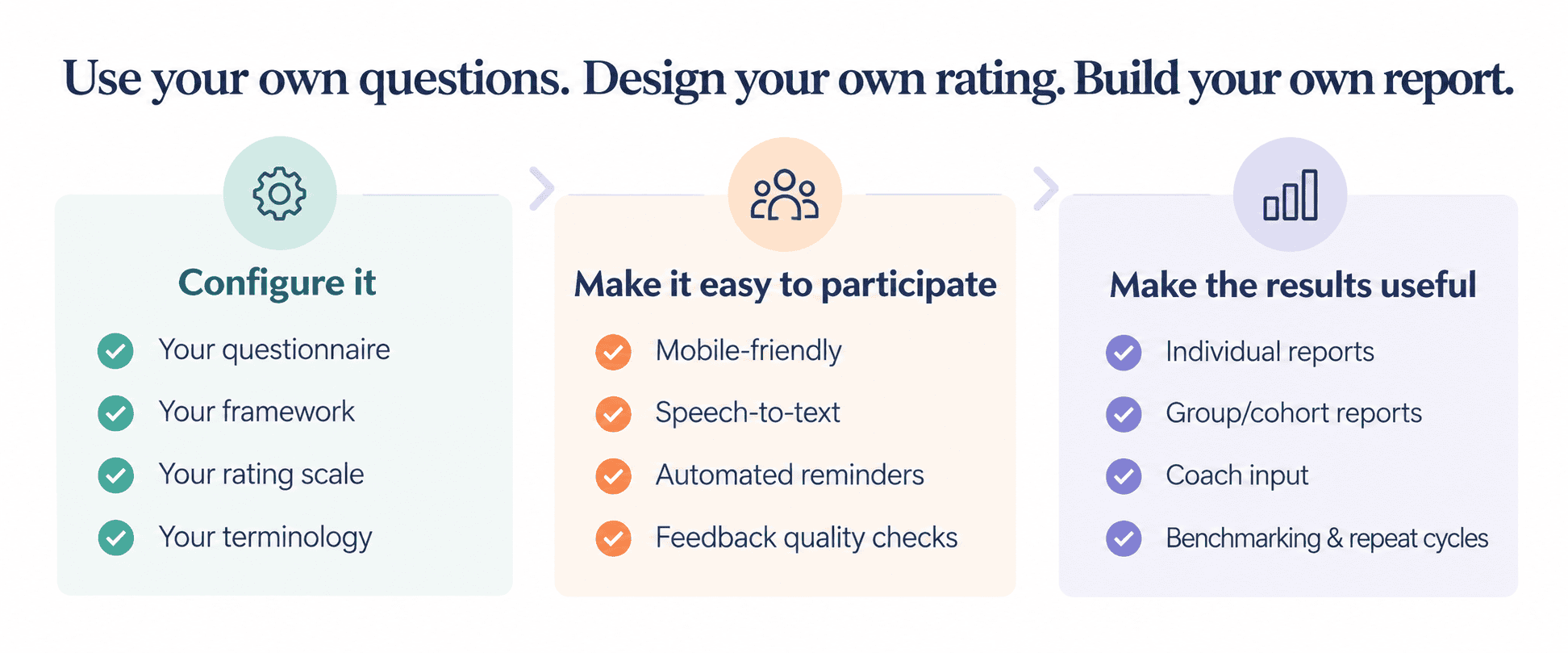
Talent 360 is configured around the competencies, values, skills and behaviours that matter to your organisation – use your existing framework and questionnaire, adapt one of ours, or work with our occupational psychology team to design or refine your assessment.
Questionnaires, frameworks, rating scales, levels and language can all be shaped to match how your organisation actually talks about performance and potential, from graduate through to executive.
Workflow follows the same principle: rollout, reminders and reporting are built around your process, not the other way round.
When does a specialist 360 platform make the difference?
If you’re running a straightforward 360 exercise, the capability already available in your HR platform may be enough.
A specialist platform becomes more valuable when the programme is more important or more complex – different questionnaires for different populations, organisation-specific frameworks, configurable anonymity, repeat measurement, group reporting, facilitated feedback or development activity after the report.
And the quality of what raters actually write is checked too – with lower quality feedback getting flagged before it reaches the report.
Many of our customers have a 360 capability within their HRIS, LMS or Talent system, yet they come to us for our specialist platform, advice and support.
Choose how you run it
Not every organisation wants to run a 360 programme the same way, so Talent 360 doesn’t force one model on everyone. You choose.
- Self-managed. Your HR team runs it all: configuring the questionnaire, managing rollout, interpreting results in-house. Full control.
- Managed. We take on the administration: following up with participants, running the rollout calendar, answering queries, so your team can focus on outcomes rather than logistics.
- Facilitated, with coaching. Feedback is delivered by a trained facilitator or coach rather than left as a report to interpret alone – the right choice for senior leadership programmes, where the conversation matters as much as the data. Want to build that capability in-house over time? Our Managers to Coach programme helps you develop your own internal coaching pool.
Turn feedback into development action
A 360 report is only useful if it tells someone something they can act on – not just how they rated, but what to do next.
Talent 360 gives you reporting built for decisions and action. You choose what goes in:
- Benchmarked against the competencies, values, skills and behaviours your organisation has defined as important.
- Comparable over repeat cycles, so you can see real development, not just a single snapshot.
- Development goals and target-role comparisons – showing where someone stands today and how they compare to the role they’re developing into.
- Visual elements that surface strengths a participant might not have recognised in themselves.
- Optional AI-suggested development priorities, reviewed and refined by the individual before it reaches their development plan.
And we help your team use AI responsibly throughout, not just switch it on.
What are you trying to achieve
What you’re using 360 for should shape how it’s built, from the questions and rating scale through to the report itself. A tool designed for annual manager development looks different from one built to evaluate a year-long leadership programme – so it’s worth being clear on the purpose before you start.
- Manager development– building the everyday capability that most organisations run 360 for in the first place.
- Leadership programmes– plotting progress over time and evaluating whether the programme itself is working, not just how individuals score.
- Executive development– where a facilitated, coached conversation usually matters as much as the report itself.
- Succession evidence– a second, structured source of insight to sit alongside manager judgement, not replace it.
- Team and group development– the same evidence rolled up to develop a whole team, not just the individuals in it.
Four Customer Stories.
The best way to understand Talent 360 is to hear how organisations actually use it. Four clients, on what working with it looks like day to day, and what it’s changed for them.
Built a bespoke competency framework around its own values rather than adopting a generic management model, and extended Talent 360 to support GMC revalidation for 180 doctors.
“Head Light offered something quite different right from the start and stood out from the competition. Even at our initial meeting, they challenged our thinking.”
Annette Cairns, Organisational Development Manager, Ramsay Health Care


Rolled out a sector-specific 360 for fire and rescue leaders following the HMICFRS report, built its own pool of internal facilitators, and positioned 360 firmly as development, not performance management.
“We now have a positive and sustainable 360 programme. The support from Head Light has been a critical success factor in this.”
Chris Marwood, People Partner, South Yorkshire Fire and Rescue

Ran 360 across multiple partner organisations at once, each with its own language and competency framework, for a leadership programme that 97% of delegates said improved their leadership capability.
“Working with Head Light is about working with a true partner: both parties understand what is expected.”
Samantha Darby, People and Leadership Consultant, West Midlands Employers
Organisational insight
Run across a team, a leadership level, or the whole organisation, the same 360 data tells you something different, spotting patterns as yet unseen: where capability is strong, where development themes repeat, and where a whole cohort needs support.
That’s a view that many organisations don’t get from basic or bundled 360 functionality.
- A shared gap across an entire management tier.
- A strength concentrated in one department but absent elsewhere.
- How a leadership cohort compares to the standard you’ve set for it.
It’s the point where individual feedback starts telling you something about the organisation as well.
Where Talent 360 goes further
On its own, 360 feedback gives someone a structured view of how their behaviours and capabilities are experienced by others. Connected to Head Light’s workforce signal layer, that evidence can contribute to a wider picture of capability, readiness and risk alongside skills, performance, succession and engagement evidence.
Talent 360 turns individual review data into evidence you can act on at every level – from one person’s development plan through to organisation-wide succession planning and workforce readiness.



Get a straight answer on whether Talent 360 fits your organisation
Book a demo and we’ll show you how it would run in your organisation – not a generic features tour, but a straight look at whether it solves what you need it to.
Complete the form and we’ll be in touch to arrange a time.
Frequently Asked
Questions
The best 360 has customisable questionnaires, automated reminders, rich analytics and configurable reporting. It is easy to access, tracks development and integrates with other talent processes.
360 helps team members to understand each other’s contribution and how they work together. It highlights areas of group development need and benchmarks pre- and post-training competence.
360 feedback can add structured behavioural evidence to succession and potential assessments, alongside performance, manager judgement and other evidence.
360 helps to benchmark the current level of a leader’s competency and identifies areas of development. Use these to build a development plan. Reassess post-development to check on progress.
Yes. Talent 360 works as a standalone tool – you don’t need the wider platform to run it. If you later want feedback data feeding into broader workforce capability reporting, it connects into that, but it’s not a requirement.
Yes. Many clients embed their existing framework, language and rating scale rather than adopting ours. If you don’t have one, or want your current framework reviewed, Head Light’s consultancy team can design or refine it with you.
Yes. You can run it fully in-house supported by our admin and facilitator training, or hand the day-to-day running to us. Most clients land somewhere in between – in-house administration with us managing questionnaire design and rollout.
Peer and direct report ratings are aggregated and never attributed to an individual in the final report unless configured to do so. Open-text comments carry more risk of identifying a rater, so as part of roll-out we help you brief participants on writing feedback that stays specific to behaviour rather than personally identifiable detail.
Yes. Questionnaires can be split however you need – by leadership level, function, or cohort – using the same core framework with level-specific questions where relevant.
Yes. Group and benchmark reporting shows strengths and development themes across a cohort, department or the whole organisation, not just individual results.
Yes. Re-running a 360 against the same framework lets you compare results over time and can show measurable movement in perceived behaviour.
Talent 360 integrates with many HR systems, through organisational imports, API calls, and Single Sign-On.